
The Gulf Coast Joint Venture (GCJV) is a partnership among Federal and State Agencies, non-profit organizations, and private landowners dedicated to the conservation of priority bird habitat along the U.S. Gulf of Mexico coast. Habitat projects are developed and implemented by 6 regional Initiative Teams of biologists and managers of public and private lands. GCJV partners include numerous other organizations and hundreds of individuals that are involved in specific collaborative habitat, planning or evaluation projects.
GCJV office staff coordinates priority bird conservation planning, delivery, and evaluation for the partnership. The GCJV office is located in the U.S. Geological Survey Wetland and Aquatic Research Center, Lafayette, Louisiana.
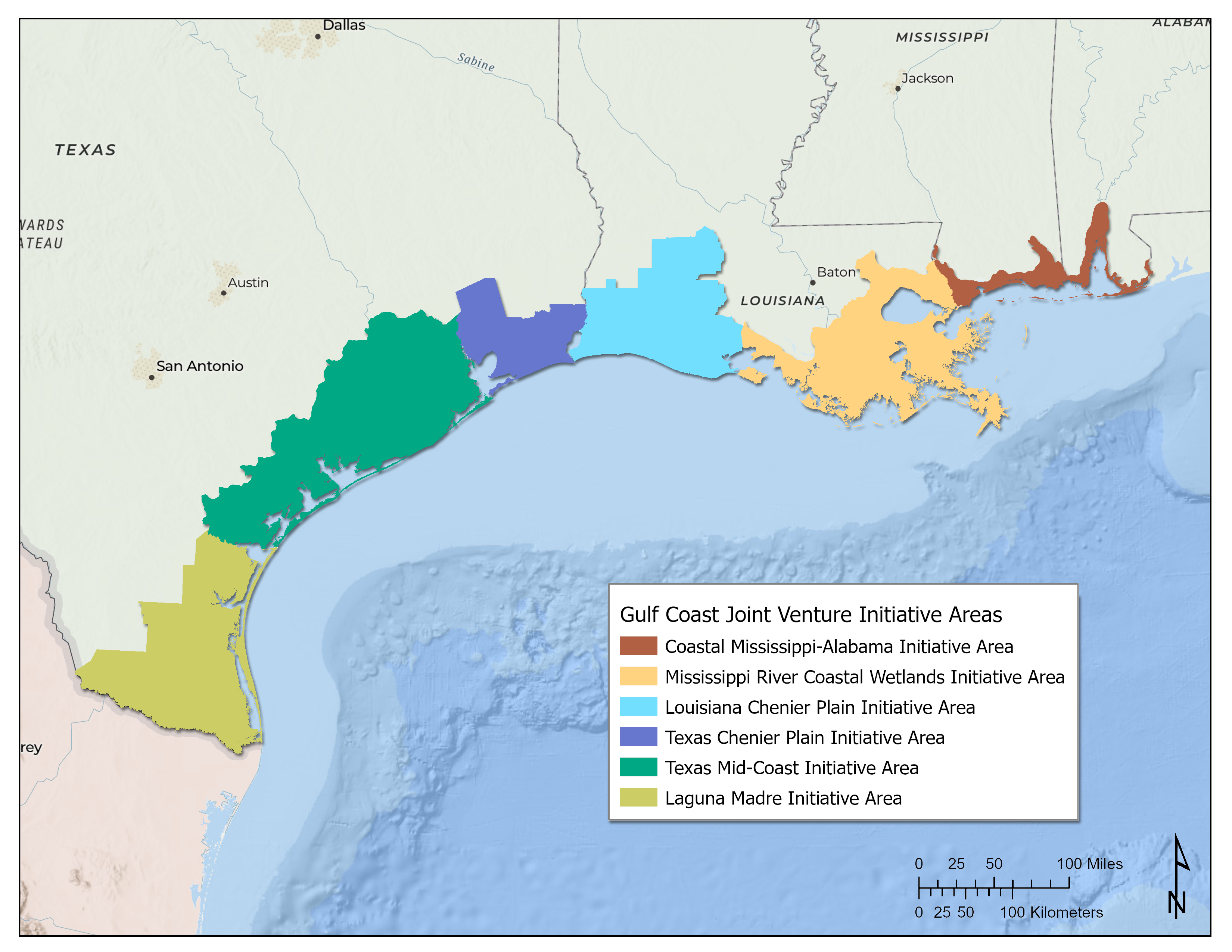
The Gulf Coast Joint Venture is divided geographically into six initiative areas, each with a different mix of habitats, management opportunities, and species priorities. Goals, objectives, and conservation strategies have been identified for every initiative area. In turn, each initiative area has an Initiative Team that plans, designs, and implements projects that are driven by conservation plans for that initiative area. Team membership is open to anyone who wants to discuss bird habitat conservation project ideas within a partnership forum of field-level biologists. The map on the left shows the individual initiative areas, and the respective Initiative Teams and their Chairperson are listed below.
GCJV Initiative Teams
Initiative Teams maintain a portfolio of proposed conservation projects that could be implemented if sufficient resources are allocated. They (through designated Initiative Team Chairpersons) regularly inform the GCJV Management Board regarding status of previously recommended projects, newly proposed projects, new project opportunities, and other needs. Initiative Teams also communicate with the GCJV Management Board to request assistance with design, funding, and implementation of proposed conservation projects for priority bird species.
Laguna Madre Initiative TeamJonathan Moczygemba, Chairperson
U.S. Fish and Wildlife Service
jonathan_moczygemba@fws.gov
Texas Mid-Coast Initiative Team
James Morel, Chairperson
Texas Parks and Wildlife Department
james.morel@tpwd.texas.gov
Texas Chenier Plain Initiative Team
Stephen McDowell, Chairperson
Texas Parks and Wildlife Department
stephen.mcdowell@tpwd.texas.gov
Louisiana Chenier Plain Initiative Team
Cassidy Lejeune, Chairperson
Ducks Unlimited
clejeune@ducks.org>
Mississippi River Coastal Wetlands Initiative Team
Angela Trahan, Chairperson
USDA-NRCS
angela.trahan@usda.gov
Coastal Mississippi-Alabama Initiative Team
Vacant, MS Co-Chairperson
Roger Clay, AL Co-Chairperson
Alabama Department of Conservation and Natural Resources
roger.clay@dcnr.alabama.gov

 700 Cajundome Blvd.
Lafayette, LA 70506
Phone: 337-262-7001 Fax: 337-262-7000
Copyright 2020 Gulf Coast Joint Venture - Webmaster